Yes, it's been a while. Enough about that. Back to blogging about physics and the environment, y'all. This stuff is for real.
A friend of mine alerted me today to a Bloomberg article about a proposed bill in Kansas to "outlaw sustainability." Now, a title like that makes you do a double take, but a good critic of science journalism always hesitates to take a sensational title too seriously, so I found the actual house bill, proposed by state congressman Hedke after, according to the Bloomberg article, "maybe a dozen" people had approached him about it.
(Man, I want to propose some bills in my own state, too! I want to propose one outlawing congressional stupidity! Maybe I should get twelve of my closest friends to give my congressman a call and he'll work something up...oh wait. Twelve of my friends aren't oil and gas lobbyists.)
Anyway, I was correct in my skepticism that "outlawing sustainability" is not exactly what this bill does--but in its own way, what the bill is actually doing is much worse. And, contrary to most hopelessly incomprehensible piece of legislation, it's also a surprising short, plain, and easy read. I've quoted it in it's entirely below, with emphasis on the things that especially stood out to me.
Showing posts with label environment. Show all posts
Showing posts with label environment. Show all posts
Wednesday, April 10, 2013


Tuesday, October 11, 2011
Are Solar Panels Just "Eco-Bling?"
This article and the subsequent comments (ignore the usual contingent of off-topic jerks and their environmental straw men) has generated some very excellent discussion about one of the fundamental questions in green building today: is renewable energy or energy efficiency more important?
The answer is "both!", of course,(but then you could get into an argument about whether any of it is worth it) but that would be an answer that denies the practicalities and subtleties we encounter in the field and in the preconceptions of our customers.
The answer is "both!", of course,(but then you could get into an argument about whether any of it is worth it) but that would be an answer that denies the practicalities and subtleties we encounter in the field and in the preconceptions of our customers.
Friday, September 23, 2011
Fire or Ice or Ecominic Turmoil?
One thing we environmentalists often get criticized for is our proclamations of a doom and gloom filled future. We recognize some problems in the way humans do things and often conclude that we can't keep doing them without consequences, and we want to understand what those consequences are and if it's important to avoid them even and especially if avoiding them has negative consequences for us now. If future consequences will be worse, we think it is really quite rational to take action now to lessen them.
The problem is, although models can be pretty predictive, while cause and effect rationality combined with observational data can make for good scientific papers, still, nobody has the entire biosphere and global economy worked out to the level of solvable equations--and nobody has a crystal ball, either. And most folks just get fed up with too many downer predictions about the future: it's far away, hard to get emotional about, and why does everybody have to be so pessimistic anyway?
The problem is, although models can be pretty predictive, while cause and effect rationality combined with observational data can make for good scientific papers, still, nobody has the entire biosphere and global economy worked out to the level of solvable equations--and nobody has a crystal ball, either. And most folks just get fed up with too many downer predictions about the future: it's far away, hard to get emotional about, and why does everybody have to be so pessimistic anyway?
Monday, September 12, 2011
Please Consider the Environment
At the bottom of a lot of many emails in this new professional world, I see quite a bit of that little wingdings picture of a landscape with mountains and a tree, made large and in green font, next to some variation on the words "Be Green! Consider the environment before printing this email!"
Maybe this is to be expected considering that I do work in the green building world. Yet apart from my department of our company, the rest of what folks do has a lot more to do with selling things than with thinking about how green they are--and somebody has to sell the stuff, and I'm sure glad it ain't me. I find it funny that the largest relic of "greenness" among the rest of my company that I can observe is a little note telling me not to print my email. (Which also happens to help the company spend a little less green on printing costs.)
And while I don't suppose that note is "greenwashing," per say--among the people who use it, their heart is probably in the right place--it does strike me as bizarre, and utterly irrelevant toward actual environmental protection.
There are two things I don't like about it. The first has to do with making something very small and maybe not something you were really inclined to do anyway seem like that's it, you did your part. Or maybe I just live in a subset of the world where most people don't really print their email--or maybe I just get more or less irrelevant email--but I don't know that many folks are really all that compelled to print their email anyway. But even so, most of sustainability has more to do with widespread systematic problems than whether or not you print ten copies of an email about your friend's dog.
The other problem is the nag factor. It's a nice friendly little reminder, but sometimes nothing grates you more than friendly little reminders about things! Especially if it's there in your signature line on every email that you send! I've posited before that this aspect of sustainability is one of our greatest challenges: personal responsibility is personal after all, is internally motivated, so sometimes friendly reminders just piss people off even if well-intentioned and they shouldn't get so uptight about it and you were just trying to help gosh. Adults don't like being told how they should do something, even if, when they considered it themselves, they might agree that the suggested way has more benefits.
In light of gripe number one, I suppose I'd rather not waste people's nag tolerance on something so trivial--or even bother people's nag tolerance at all.
Maybe this is to be expected considering that I do work in the green building world. Yet apart from my department of our company, the rest of what folks do has a lot more to do with selling things than with thinking about how green they are--and somebody has to sell the stuff, and I'm sure glad it ain't me. I find it funny that the largest relic of "greenness" among the rest of my company that I can observe is a little note telling me not to print my email. (Which also happens to help the company spend a little less green on printing costs.)
And while I don't suppose that note is "greenwashing," per say--among the people who use it, their heart is probably in the right place--it does strike me as bizarre, and utterly irrelevant toward actual environmental protection.
There are two things I don't like about it. The first has to do with making something very small and maybe not something you were really inclined to do anyway seem like that's it, you did your part. Or maybe I just live in a subset of the world where most people don't really print their email--or maybe I just get more or less irrelevant email--but I don't know that many folks are really all that compelled to print their email anyway. But even so, most of sustainability has more to do with widespread systematic problems than whether or not you print ten copies of an email about your friend's dog.
The other problem is the nag factor. It's a nice friendly little reminder, but sometimes nothing grates you more than friendly little reminders about things! Especially if it's there in your signature line on every email that you send! I've posited before that this aspect of sustainability is one of our greatest challenges: personal responsibility is personal after all, is internally motivated, so sometimes friendly reminders just piss people off even if well-intentioned and they shouldn't get so uptight about it and you were just trying to help gosh. Adults don't like being told how they should do something, even if, when they considered it themselves, they might agree that the suggested way has more benefits.
In light of gripe number one, I suppose I'd rather not waste people's nag tolerance on something so trivial--or even bother people's nag tolerance at all.
Monday, July 11, 2011
A Green Building Roadmap
“Green Building” is an advancing and mature industry--although as I've said before, "sustainable" is a more accurate term than "green,” which is a color that has been hijacked over the years to also mean "less bad for the environment." Notice I did not say "good for the environment," which is what is what most marketing departments (including ours) who brandish the word "green" would kinda hope you think they mean.
The green building industry exists because environmentalists and otherwise concerned citizens have recognized that there are problems we need to address with modern buildings. Most every building built in this post-modern era, even the self-described “green” ones, actually create net degradation of the environment: we take a plot of land that was home to myriad species of plants, insects, even wildlife, and turn it into an environment for just a few of members of the single species Homo sapiens, and maybe some dogs, cats, and goldfish. That is not a problem in itself, as Homo sapiens need habitat too and since we’re generally bigger we ought to have a larger space for ourselves, but it is an increasingly artificial one, and one that has grown in size 37% since 1980 while dropping in occupant density by 10%. (Yes, and 99% of statistics are made up on the spot...) Yet we also build that house using an host of materials that were extracted from some other environment somewhere and combobulated into what they are now with the help of much fossil fuels, often imbued with synthetic and potentially environmentally-toxic and human-toxic chemicals that may affect the environment long after the building itself is gone. Throughout the life of this building, we will be taking further from the environment: using clean drinking water and spitting it out much less clean, poisoning insects and plants that try to re-encroach, consuming electricity and maybe burning a fossil fuel for heat. And, perhaps most importantly of all, burning fossil fuels to travel from this building each and every day to all the other buildings in which we have business, maybe multiple times a day, maybe regularly to buildings that are very far away.
So when I say a "green" home, or even a sustainable one, I'm talking about a home that does all of these things in a way that is less bad, from an environmental perspective. Moving from a "green" home and onto a "sustainable" one, the absolute ideal would be one that does all this in a way that is somehow calculated to be environmentally neutral--sustainable, after all, is defined as something that can be continued into the future without degradation of the resources available to make this happen for everybody who might want a home for themselves.
Attacking this room for improvement is how companies like mine thrive: a market of customers exist who want this stuff because the environment matters to them, and so people like me and my colleagues put research and work into finding ways to make that happen. By experimenting and doing we create more alternatives for the entire industry on how to do more things "less badly."
There are different levels of commitment to these alternative ways of building. Not all "green" homes are created equal, and most “green” homes are not yet truly “sustainable.”
Level One: Look Ma, I Got Solar Panels
These homes have something conventionally “green” about them: maybe they have some solar panels; maybe they hooked up some rain barrels to their gutters; or used recycled aluminum roofing or low-VOC paints and finishes. Perhaps a whole smorgasbord of such things. And these hearts are in the right place—but there remains an important environmental elephant in the room: maybe the house is also 4,000 square feet even though only two people live in it, or is 40 miles from work and the nearest grocery store, or they installed an awesome solar hot water kit but end up paying tons in energy bills anyway because they skimped on insulation. The owners made some choices that were “green” because it was something they knew about or were concerned about—but they also made other choices having to do with entirely different motivations, and some of those motivations had no consideration for the environment. Overall, the environmental picture may be better than if no thought had gone into it at all, but the picture is decidedly piecemeal.
Level Two: An Energy Star Home
Energy Star is not just for appliances anymore--now there is an extensive certification program for houses themselves, put together by our own EPA. Anyone building a new home can elect to certify it as an Energy Star home by following a very detailed set of guidelines aimed at reducing energy consumption by a certain threshold. A certified professional will inspect and test the home to verify that all the guidelines have been followed. Since operating a building involves ongoing electricity and heating fuel costs, and those costs persist throughout the multi-decade life of a building, come what may in terms of oil embargoes or carbon regulation, energy efficiency is a great place to start purely from a financial standpoint, as well as from an environmental one.
There are many things that can only be done when the house is built that will affect the energy efficiency of the home throughout the entire life of the home--small details, often, that are missed simply through lack of intentioned attention to those details because of lack of knowledge on the part of the builder or of insistence on the part of the homeowner. Energy Star uses several decades of forward-thinking builder experimentation and academic research in just those things to make sure that a few more of them get done than are done in typical construction.
Building a house to Energy Star standards requires a little bit more work and a little bit more up-front cost, but also has a very good payback for the homeowner. It's a smart way to get an incrementally higher quality house for not such a load of extra effort. And it's a really smart way for builders to differentiate themselves from rivals. One of my biggest successes in my job has been to develop and implement our process for easily allowing our houses to get this certification, for those customers who want it.
Level Three: A LEED Certified Home
LEED is so well-known now that most people recognize as having something to do with green building. Its parent non-profit organization is also getting sued for false advertising because some early LEED homes did not deliver the energy performance advertised--but that's a different story.
LEED is very similar to Eenergy Star in that it is a voluntary certification program that interested builders can earn by following the guidelines of a vast amount of checklists (ever been in scouting and earned a merit badge? The process is similar, although on a much larger scale), and having all of that work verified by a LEED-certified professional. The main difference between LEED and Energy Star, besides the fact that the former was created first by an independent organization and the latter was created later by the government, is that LEED addresses more than just energy efficiency. The energy efficient section of LEED has requirements that look a lot like the Energy Star requirements. But then there is the water efficiency section, the materials and resources section, the job-site protection and restoration section, and the indoor air quality section. LEED is harder than Energy Star because you have to pay attention to far more aspects of the building than just the energy efficiency.
Level Four: A Net-Zero Home
This is another of my projects: designing a prototype Net-Zero home for my company.
A Net-Zero home is not a current market item, like a LEED or Energy Star home is. It is a future market item, anticipating a world where energy prices continue to rise, climate change drives further environmental awareness, and countries get serious about curing carbon dioxide emissions. That's the advantage of a company with a sustainability department--we're the ones with our ears to the ground about the future, supporting company sustainability as well as environmental sustainability of our practices.* Net-Zero prototypes and communities are popping up all over the U.S.--but most people don't live in a Net-Zero home yet. To continue to differentiate ourselves, we can hardly call ourselves "the original green builder," as we do, and NOT have a net-zero prototype to show.
So what is Net-Zero?
It is moving past "less bad" and on to "so less bad it is in fact neutral." A net-zero home uses no more energy than it produces. With current technology that necessitates on-site renewable energy, but it's not so simple as sticking up an array of solar panels and calling it a day--because super-rich hippies can do that but not too many other people can, and if this really is the next market and one that can help society be more sustainable at that, it has to be attainable by a larger swath of potential homeowners.
Completely self-sufficient living by renewable energy is not a new concept—but it is not a mainstream one. Net-Zero tries to make sustainable living more mainstream--and it does so by a compromise between many considerations, a balancing act. While not a tiny solar cabin in the woods, a net-zero home will be on the smaller side: none of that man-cave in the basement plus formal living room and dining room with media room to boot suburbia trend--but it will be designed to still feel like a normal house. It will also have double or triple the amount of insulation, passive solar design where possible, extremely efficient heating and cooling, will manage electrical loads in an intelligent way, and it will be designed to be affordable. Not typical-house-affordable, because that is right now impossible--but as affordable as it can be. As more builders make their net-zero prototypes, we learn more about what is possible and bring more and more of these ideas into the mainstream at lower cost.
Notice that net-zero is neutral from an energy standpoint only—and only neutral when it relates to site energy at that. It does not touch the relative efficiencies of electricity verses other forms of energy and of getting it to the house to begin with, it does not touch all the energy it took to manufacture all of those state-of-the-art energy efficient technologies, and it doesn’t touch other aspects of environmental harm, like LEED does. But that so many prototypes exist shows that it a very achievable step, coming, perhaps soon, to a neighborhood near you.
Level Four-A: A Passive Haus
Passive House, or Passive Haus, since it is a German invention, is another independently developed building certification program. Not quite a separate level on its own, Passive Haus is sustainable building for the truly nerdy among us: the spreadsheets, the little scaling factors and time-dependent solar radiant calculations… Passive Houses share the goal with Net-Zero houses of neutral energy consumption, but where as Net-Zero tries to accomplish the goal while balancing cost and "conventionalness" of living, Passive Haus accomplishes the goal by a nerd-out, all-stops-pulled, putting-sustainability-before-any-other-consideration approach. As a nerd myself, I love it. Its also an incredibly tough standard. It uses very basic, low-tech ideas, but takes those ideas and engineers them ad nausium. Many of those non-energy-related but still important environmental factors, such as water use and site-restoration come into play just by this intense design approach, although they are not strictly evaluated as part of the standard.
The Next Level: ?
As you can see, the green building industry is about movement: from conventional practices to less harmful ones, from practices that reduce energy consumption to ones that do that and are less toxic too, or consider life-cycle energy costs as well as just energy use, to processes that are also water efficient, etc. It embodies the idea of better living through iterative refinement. So the next step after “less bad” and “neutral,” is…”good for,” or “improves upon.” Since actually achieving neutral is what’s on our horizon now, and is only generally neutral as it relates to site energy, we have a very long way to go and a lot of details to fill in to get to the “makes better” road marker.
I believe climate change will throw an interesting wrench in all of this—as keeping our habitat safe and comfortable will get much more difficult in a world of deeper weather extremes. In addition to asking our homes to provide shelter and comfort while also not hurting the environment too much, we might also have to start asking them to provide increased levels of self-sufficiency, as more frequent heat, drought, floods, and storms will change and reduce the reliability of our existing infrastructure. Disaster resilience may be the net big green building boom.
* In my future, we will either put up the money to build a prototype net-zero home and try to market the heck out of it and my work for the next couple of years will be really rewarding and interesting--or we won't, and the notebook will sit on my boss's desk for an undetermined amount of months and years. Such is the whim of the economy.
The green building industry exists because environmentalists and otherwise concerned citizens have recognized that there are problems we need to address with modern buildings. Most every building built in this post-modern era, even the self-described “green” ones, actually create net degradation of the environment: we take a plot of land that was home to myriad species of plants, insects, even wildlife, and turn it into an environment for just a few of members of the single species Homo sapiens, and maybe some dogs, cats, and goldfish. That is not a problem in itself, as Homo sapiens need habitat too and since we’re generally bigger we ought to have a larger space for ourselves, but it is an increasingly artificial one, and one that has grown in size 37% since 1980 while dropping in occupant density by 10%. (Yes, and 99% of statistics are made up on the spot...) Yet we also build that house using an host of materials that were extracted from some other environment somewhere and combobulated into what they are now with the help of much fossil fuels, often imbued with synthetic and potentially environmentally-toxic and human-toxic chemicals that may affect the environment long after the building itself is gone. Throughout the life of this building, we will be taking further from the environment: using clean drinking water and spitting it out much less clean, poisoning insects and plants that try to re-encroach, consuming electricity and maybe burning a fossil fuel for heat. And, perhaps most importantly of all, burning fossil fuels to travel from this building each and every day to all the other buildings in which we have business, maybe multiple times a day, maybe regularly to buildings that are very far away.
So when I say a "green" home, or even a sustainable one, I'm talking about a home that does all of these things in a way that is less bad, from an environmental perspective. Moving from a "green" home and onto a "sustainable" one, the absolute ideal would be one that does all this in a way that is somehow calculated to be environmentally neutral--sustainable, after all, is defined as something that can be continued into the future without degradation of the resources available to make this happen for everybody who might want a home for themselves.
Attacking this room for improvement is how companies like mine thrive: a market of customers exist who want this stuff because the environment matters to them, and so people like me and my colleagues put research and work into finding ways to make that happen. By experimenting and doing we create more alternatives for the entire industry on how to do more things "less badly."
There are different levels of commitment to these alternative ways of building. Not all "green" homes are created equal, and most “green” homes are not yet truly “sustainable.”
Level One: Look Ma, I Got Solar Panels
These homes have something conventionally “green” about them: maybe they have some solar panels; maybe they hooked up some rain barrels to their gutters; or used recycled aluminum roofing or low-VOC paints and finishes. Perhaps a whole smorgasbord of such things. And these hearts are in the right place—but there remains an important environmental elephant in the room: maybe the house is also 4,000 square feet even though only two people live in it, or is 40 miles from work and the nearest grocery store, or they installed an awesome solar hot water kit but end up paying tons in energy bills anyway because they skimped on insulation. The owners made some choices that were “green” because it was something they knew about or were concerned about—but they also made other choices having to do with entirely different motivations, and some of those motivations had no consideration for the environment. Overall, the environmental picture may be better than if no thought had gone into it at all, but the picture is decidedly piecemeal.
Level Two: An Energy Star Home
Energy Star is not just for appliances anymore--now there is an extensive certification program for houses themselves, put together by our own EPA. Anyone building a new home can elect to certify it as an Energy Star home by following a very detailed set of guidelines aimed at reducing energy consumption by a certain threshold. A certified professional will inspect and test the home to verify that all the guidelines have been followed. Since operating a building involves ongoing electricity and heating fuel costs, and those costs persist throughout the multi-decade life of a building, come what may in terms of oil embargoes or carbon regulation, energy efficiency is a great place to start purely from a financial standpoint, as well as from an environmental one.
There are many things that can only be done when the house is built that will affect the energy efficiency of the home throughout the entire life of the home--small details, often, that are missed simply through lack of intentioned attention to those details because of lack of knowledge on the part of the builder or of insistence on the part of the homeowner. Energy Star uses several decades of forward-thinking builder experimentation and academic research in just those things to make sure that a few more of them get done than are done in typical construction.
Building a house to Energy Star standards requires a little bit more work and a little bit more up-front cost, but also has a very good payback for the homeowner. It's a smart way to get an incrementally higher quality house for not such a load of extra effort. And it's a really smart way for builders to differentiate themselves from rivals. One of my biggest successes in my job has been to develop and implement our process for easily allowing our houses to get this certification, for those customers who want it.
Level Three: A LEED Certified Home
LEED is so well-known now that most people recognize as having something to do with green building. Its parent non-profit organization is also getting sued for false advertising because some early LEED homes did not deliver the energy performance advertised--but that's a different story.
LEED is very similar to Eenergy Star in that it is a voluntary certification program that interested builders can earn by following the guidelines of a vast amount of checklists (ever been in scouting and earned a merit badge? The process is similar, although on a much larger scale), and having all of that work verified by a LEED-certified professional. The main difference between LEED and Energy Star, besides the fact that the former was created first by an independent organization and the latter was created later by the government, is that LEED addresses more than just energy efficiency. The energy efficient section of LEED has requirements that look a lot like the Energy Star requirements. But then there is the water efficiency section, the materials and resources section, the job-site protection and restoration section, and the indoor air quality section. LEED is harder than Energy Star because you have to pay attention to far more aspects of the building than just the energy efficiency.
Level Four: A Net-Zero Home
This is another of my projects: designing a prototype Net-Zero home for my company.
A Net-Zero home is not a current market item, like a LEED or Energy Star home is. It is a future market item, anticipating a world where energy prices continue to rise, climate change drives further environmental awareness, and countries get serious about curing carbon dioxide emissions. That's the advantage of a company with a sustainability department--we're the ones with our ears to the ground about the future, supporting company sustainability as well as environmental sustainability of our practices.* Net-Zero prototypes and communities are popping up all over the U.S.--but most people don't live in a Net-Zero home yet. To continue to differentiate ourselves, we can hardly call ourselves "the original green builder," as we do, and NOT have a net-zero prototype to show.
So what is Net-Zero?
It is moving past "less bad" and on to "so less bad it is in fact neutral." A net-zero home uses no more energy than it produces. With current technology that necessitates on-site renewable energy, but it's not so simple as sticking up an array of solar panels and calling it a day--because super-rich hippies can do that but not too many other people can, and if this really is the next market and one that can help society be more sustainable at that, it has to be attainable by a larger swath of potential homeowners.
Completely self-sufficient living by renewable energy is not a new concept—but it is not a mainstream one. Net-Zero tries to make sustainable living more mainstream--and it does so by a compromise between many considerations, a balancing act. While not a tiny solar cabin in the woods, a net-zero home will be on the smaller side: none of that man-cave in the basement plus formal living room and dining room with media room to boot suburbia trend--but it will be designed to still feel like a normal house. It will also have double or triple the amount of insulation, passive solar design where possible, extremely efficient heating and cooling, will manage electrical loads in an intelligent way, and it will be designed to be affordable. Not typical-house-affordable, because that is right now impossible--but as affordable as it can be. As more builders make their net-zero prototypes, we learn more about what is possible and bring more and more of these ideas into the mainstream at lower cost.
Notice that net-zero is neutral from an energy standpoint only—and only neutral when it relates to site energy at that. It does not touch the relative efficiencies of electricity verses other forms of energy and of getting it to the house to begin with, it does not touch all the energy it took to manufacture all of those state-of-the-art energy efficient technologies, and it doesn’t touch other aspects of environmental harm, like LEED does. But that so many prototypes exist shows that it a very achievable step, coming, perhaps soon, to a neighborhood near you.
Level Four-A: A Passive Haus
Passive House, or Passive Haus, since it is a German invention, is another independently developed building certification program. Not quite a separate level on its own, Passive Haus is sustainable building for the truly nerdy among us: the spreadsheets, the little scaling factors and time-dependent solar radiant calculations… Passive Houses share the goal with Net-Zero houses of neutral energy consumption, but where as Net-Zero tries to accomplish the goal while balancing cost and "conventionalness" of living, Passive Haus accomplishes the goal by a nerd-out, all-stops-pulled, putting-sustainability-before-any-other-consideration approach. As a nerd myself, I love it. Its also an incredibly tough standard. It uses very basic, low-tech ideas, but takes those ideas and engineers them ad nausium. Many of those non-energy-related but still important environmental factors, such as water use and site-restoration come into play just by this intense design approach, although they are not strictly evaluated as part of the standard.
The Next Level: ?
As you can see, the green building industry is about movement: from conventional practices to less harmful ones, from practices that reduce energy consumption to ones that do that and are less toxic too, or consider life-cycle energy costs as well as just energy use, to processes that are also water efficient, etc. It embodies the idea of better living through iterative refinement. So the next step after “less bad” and “neutral,” is…”good for,” or “improves upon.” Since actually achieving neutral is what’s on our horizon now, and is only generally neutral as it relates to site energy, we have a very long way to go and a lot of details to fill in to get to the “makes better” road marker.
I believe climate change will throw an interesting wrench in all of this—as keeping our habitat safe and comfortable will get much more difficult in a world of deeper weather extremes. In addition to asking our homes to provide shelter and comfort while also not hurting the environment too much, we might also have to start asking them to provide increased levels of self-sufficiency, as more frequent heat, drought, floods, and storms will change and reduce the reliability of our existing infrastructure. Disaster resilience may be the net big green building boom.
* In my future, we will either put up the money to build a prototype net-zero home and try to market the heck out of it and my work for the next couple of years will be really rewarding and interesting--or we won't, and the notebook will sit on my boss's desk for an undetermined amount of months and years. Such is the whim of the economy.
Sunday, May 1, 2011
Environmentalism and Question I Don't Have Answers To
It seems that most environmental policy involves regulation by a governing body, and most environmentalism on a personal level involves self-sacrifice. If we are going to get serious, really serious, about the issue of climate change, is it inevitable that we adopt heavy-handed government mandates to get our emissions under control?
As environmentalists, do we just have to accept that human nature is to fail to grasp environmental consequences until bad problems result, and so helpful actions must be externally enforced to have a hope of being implemented effectively?
I'm not sure that I know enough about economics or sociology to intelligently answer this question--but it is an important one, because it cuts to the heart of some of the political difficulties with environmentalism. Because on the other side of the argument is the Rand-ian elevation of individual rights and the critical importance of personal liberty in allowing creativity and innovation. In this view government regulation only stifles our potential, and individuals doing things for the greater good or against inclination is not just silly, it's immoral, in part because who has the right to define "greater good?"
There is plenty of evidence that lack of oversight is detrimental: Hardin's Tragedy of the Commons is a great place to start. But does that oversight have to come from the government? And is regulation from the government in the name of curtailing our own tendencies toward destruction really such a bad thing?
I find it extremely hard to believe that X Large Manufacturing Company That Happens to Have a Polluting Process, absent any environmental regulation, is going to add any environmental safeguards just cause hey that's the right thing to do. The employees might have the same desire for clean air and water that we do, but if all the competitors of X aren't doing it, X would go out of business if it chose to raise it's overhead cost in a way no other competitor was bothering to do, and the employees of X would also like to have jobs. But if the playing field has been made level to the point that all of X's competitors must treat their sludge and scrub their smoke stacks, that becomes the cost of doing business. Sure, I the consumer pay a higher price. But you know what, the price I would otherwise pay is chloride rivers and asthma, and honestly a higher price for a good is a bargain in comparison. It's not just that clean air and clean water are pretty and endemically valuable in themselves, although they are that, it's that the doctor's bill for asthma costs a lot of money, it's that chloride rivers might contaminate my drinking supply without somebody ensuring it doesn't, it's that if I ever wanted to start my own business using that river that wouldn't work if it were chloride, well that's just too bad.
In other words, clean air and water regulations have to be the cost of doing business, because otherwise, dirty air and dirty water are going to be the costs of having an economy--but only an economy which allows for dirty air and dirty water activities. Personally I'd rather have a diverse economy and clean air and water too. I've seen economists argue that these things are still luxuries when compared to the basic necessity of employment in order to gain sustenance, and sure, when our grand economy developed, we didn't have those things. And we realized how bad an idea that was, and consequently we are not Haiti. As for clean air and clean water verses money to eat--one will kill you sooner yet too much of the other may well kill you later, but either way, life's better if you can have both.
That leads me to climate change, because we've sort of mostly figured out how to create a decent balance of clean air, clean water, and economy, but we're still at a loss about how and even if to do something about carbon emissions while maintaining an economy and standard of living that depend deeply upon emitting carbon. There is no other way to describe this unique situation in history except to say that it royally sucks. And it looks like most of the feeble solutions we've come up with are full of imperfection on many fronts, heavy-handed government intervention and the necessity of mass personal sacrifice being high among them.
Two ideas, both of which are politically dead as dead can be, match two common economic strategies for dealing with "externalities," which in economic terms are bad consequences caused by an entity which don't directly penalize that entity, resulting in little incentive within the market structure to do much about it. One could call climate change the largest externality our global economy has ever created. One proposed solution is a tax on carbon, getting everybody who uses it, which is most of us, to pay per unit of use. When the price of something goes up, demand goes down, so that would force reductions somewhere along the way. Since people use carbon as a matter of necessity for things likes getting to jobs that give sustenance and getting the sustenance to stores too, that is going to have bad consequences for those who can't afford the higher price, the counter argument being that none of us can afford climate change and this way we are, at least, fairly paying according to our contribution thereof.
Another dead solution is a carbon cap and trade scheme, which mimics what we've already done with decent success to get other air pollutants under control. This seemingly puts the cost on large-scale polluters but will really put it on us too, because anybody providing a service whose costs go up must of necessity raise their prices all the same as if we'd all been taxed. The advantage, in my mind, in this kind of approach, is that it allows companies already doing better at reducing their emissions to be rewarded, and in general leaves more room for innovating in order to comply with the rules.
Both of those involve heavy government intervention--but they are still market solutions, far from "this must be this way" laws. Yet both of those were politically killed dead by most Republicans and not a small number of Democrats, see once again "wow this situation sucks" and the fact that no matter what we choose, some people are going to be burdened.
Other solutions: "investment in the green economy." I don't think this will work without further clarification of intent, because what is the "green economy" really? "Green jobs" seems to mean jobs for people who go out and install solar panels and put insulation in your attic--but somebody's got to be buying those solar panels and that insulation first--does the average homeowner have money for that? I sure as heck don't, and my observation is that despite everyone clamoring about how great that economy will be, these "green jobs" are largely a myth at the moment. Maybe Science! will give us new renewable energy and nuclear technology that will be awesome, but we need workable solutions now already, and have quite a few at least workable technologies already, with only economics and rapidly only politics standing in their way.
Ron Paul, as one example of the opposition to governmental intervention in all things environment, when he's not calling climate change a hoax, insists that removing oil subsidies and letting the price be what it is will go a long way to fix the problem naturally--again, not without pain. George W. Bush shared this sentiment, and sometimes attempted to structure policies this way while he was in office. It seems to me that doing this would at the very least solve a few birds with one stone: cut deficits though perhaps not substantially, have the same effect as carbon tax without having to actually tax people and deal with the associated bureaucracy, and would likely work to reduce carbon emissions as well as any other idea. And it may well severely staunch our recovery by damaging the oil and gas industry which even now employs millions of Americans.
None of these fixes are what I would call socialism, and have been shot down for economic reasons, rather than philosophical ones. Yet a rising timbre in American political discourse pre- 2012 election calls for reduced business regulation and also a symbolic return of rugged individualism to the tune of Ayn Rand, and this does not seem to bode well for fixing an externality associated with a large swath of our individual behaviors. And so with all proposed solutions so far struck down and a new sentiment a'brewing, this raises the philosophical question: are there any solution to climate change that don't involve unprecedented self-sacrifice where it's willing and social engineering where it's not? Do all practical environmental solutions equate to accepting some incremental new level of socialism, and is that always such a terrible thing?
As environmentalists, do we just have to accept that human nature is to fail to grasp environmental consequences until bad problems result, and so helpful actions must be externally enforced to have a hope of being implemented effectively?
I'm not sure that I know enough about economics or sociology to intelligently answer this question--but it is an important one, because it cuts to the heart of some of the political difficulties with environmentalism. Because on the other side of the argument is the Rand-ian elevation of individual rights and the critical importance of personal liberty in allowing creativity and innovation. In this view government regulation only stifles our potential, and individuals doing things for the greater good or against inclination is not just silly, it's immoral, in part because who has the right to define "greater good?"
There is plenty of evidence that lack of oversight is detrimental: Hardin's Tragedy of the Commons is a great place to start. But does that oversight have to come from the government? And is regulation from the government in the name of curtailing our own tendencies toward destruction really such a bad thing?
I find it extremely hard to believe that X Large Manufacturing Company That Happens to Have a Polluting Process, absent any environmental regulation, is going to add any environmental safeguards just cause hey that's the right thing to do. The employees might have the same desire for clean air and water that we do, but if all the competitors of X aren't doing it, X would go out of business if it chose to raise it's overhead cost in a way no other competitor was bothering to do, and the employees of X would also like to have jobs. But if the playing field has been made level to the point that all of X's competitors must treat their sludge and scrub their smoke stacks, that becomes the cost of doing business. Sure, I the consumer pay a higher price. But you know what, the price I would otherwise pay is chloride rivers and asthma, and honestly a higher price for a good is a bargain in comparison. It's not just that clean air and clean water are pretty and endemically valuable in themselves, although they are that, it's that the doctor's bill for asthma costs a lot of money, it's that chloride rivers might contaminate my drinking supply without somebody ensuring it doesn't, it's that if I ever wanted to start my own business using that river that wouldn't work if it were chloride, well that's just too bad.
In other words, clean air and water regulations have to be the cost of doing business, because otherwise, dirty air and dirty water are going to be the costs of having an economy--but only an economy which allows for dirty air and dirty water activities. Personally I'd rather have a diverse economy and clean air and water too. I've seen economists argue that these things are still luxuries when compared to the basic necessity of employment in order to gain sustenance, and sure, when our grand economy developed, we didn't have those things. And we realized how bad an idea that was, and consequently we are not Haiti. As for clean air and clean water verses money to eat--one will kill you sooner yet too much of the other may well kill you later, but either way, life's better if you can have both.
That leads me to climate change, because we've sort of mostly figured out how to create a decent balance of clean air, clean water, and economy, but we're still at a loss about how and even if to do something about carbon emissions while maintaining an economy and standard of living that depend deeply upon emitting carbon. There is no other way to describe this unique situation in history except to say that it royally sucks. And it looks like most of the feeble solutions we've come up with are full of imperfection on many fronts, heavy-handed government intervention and the necessity of mass personal sacrifice being high among them.
Two ideas, both of which are politically dead as dead can be, match two common economic strategies for dealing with "externalities," which in economic terms are bad consequences caused by an entity which don't directly penalize that entity, resulting in little incentive within the market structure to do much about it. One could call climate change the largest externality our global economy has ever created. One proposed solution is a tax on carbon, getting everybody who uses it, which is most of us, to pay per unit of use. When the price of something goes up, demand goes down, so that would force reductions somewhere along the way. Since people use carbon as a matter of necessity for things likes getting to jobs that give sustenance and getting the sustenance to stores too, that is going to have bad consequences for those who can't afford the higher price, the counter argument being that none of us can afford climate change and this way we are, at least, fairly paying according to our contribution thereof.
Another dead solution is a carbon cap and trade scheme, which mimics what we've already done with decent success to get other air pollutants under control. This seemingly puts the cost on large-scale polluters but will really put it on us too, because anybody providing a service whose costs go up must of necessity raise their prices all the same as if we'd all been taxed. The advantage, in my mind, in this kind of approach, is that it allows companies already doing better at reducing their emissions to be rewarded, and in general leaves more room for innovating in order to comply with the rules.
Both of those involve heavy government intervention--but they are still market solutions, far from "this must be this way" laws. Yet both of those were politically killed dead by most Republicans and not a small number of Democrats, see once again "wow this situation sucks" and the fact that no matter what we choose, some people are going to be burdened.
Other solutions: "investment in the green economy." I don't think this will work without further clarification of intent, because what is the "green economy" really? "Green jobs" seems to mean jobs for people who go out and install solar panels and put insulation in your attic--but somebody's got to be buying those solar panels and that insulation first--does the average homeowner have money for that? I sure as heck don't, and my observation is that despite everyone clamoring about how great that economy will be, these "green jobs" are largely a myth at the moment. Maybe Science! will give us new renewable energy and nuclear technology that will be awesome, but we need workable solutions now already, and have quite a few at least workable technologies already, with only economics and rapidly only politics standing in their way.
Ron Paul, as one example of the opposition to governmental intervention in all things environment, when he's not calling climate change a hoax, insists that removing oil subsidies and letting the price be what it is will go a long way to fix the problem naturally--again, not without pain. George W. Bush shared this sentiment, and sometimes attempted to structure policies this way while he was in office. It seems to me that doing this would at the very least solve a few birds with one stone: cut deficits though perhaps not substantially, have the same effect as carbon tax without having to actually tax people and deal with the associated bureaucracy, and would likely work to reduce carbon emissions as well as any other idea. And it may well severely staunch our recovery by damaging the oil and gas industry which even now employs millions of Americans.
None of these fixes are what I would call socialism, and have been shot down for economic reasons, rather than philosophical ones. Yet a rising timbre in American political discourse pre- 2012 election calls for reduced business regulation and also a symbolic return of rugged individualism to the tune of Ayn Rand, and this does not seem to bode well for fixing an externality associated with a large swath of our individual behaviors. And so with all proposed solutions so far struck down and a new sentiment a'brewing, this raises the philosophical question: are there any solution to climate change that don't involve unprecedented self-sacrifice where it's willing and social engineering where it's not? Do all practical environmental solutions equate to accepting some incremental new level of socialism, and is that always such a terrible thing?
Wednesday, February 16, 2011
Value is Valuable
When I first considered the green building/energy efficiency field, I admit my interest was 40% nerd-out to all the cool and interesting technological applications and 60% well here's an important way to save the planet.
The environmental importance of green building is nothing to understate: building operation accounts for 35% of global energy consumption--the largest portion of that is associated with heating and cooling--while the manufacture, transportation, and construction of buildings and building components alone accounts for 5% to 8% of US greenhouse gas emissions.
Yet there are so many houses, and no matter how many net-zero homes we start building, the majority of the people are living in a building whose carbon emissions could be reduced with available technology but not with the available economics. You can add in land-use concerns about building new buildings on undeveloped land in a world where we already need to be preserving natural spaces as potential carbon sequestration, and it's clear that no matter how nerdily-cool are many products, ideas, and systems available for the buildings of the future, the buildings that are already built are what need attention, even though the money to take an existing structure with yesterday's technology and vastly re-doing it with tomorrow's is not there for the majority of the people who own the majority of present buildings.
What I've found is that I care about "green building", energy efficiency, thoughtful design, how to do retrofits--all of it--for an additional reason, the more I do it--since money is so important in decisions made both by the individuals who own these homes and the companies who are trying to find a niche to make this stuff happen. That reason is value itself, and being part of an industry that takes the time to give people something that really is equal to the advertised value. Green building is about green but it's also about quality, and that is partially because "green" things like saving energy and avoiding wasteful use of materials are really about doing things right rather than just doing them nominally. It's not just shoving in extra insulation, it's installing the insulation in a way that makes it actually perform to the level advertised on the package--since you know, you are paying for that level of performance when you bought the material. It's not just putting on the "eco" windows and gutter option cause somebody told you it's green, it's thinking about how the environment will affect the house so that five or ten years from now the house doesn't fall down due to all the studs around your window being completely rotted out from a hidden leak-- since going into debt for thirty years on a product that only lasts ten is nobody's idea of a good deal. Maybe the house would have cost you more to buy if your builder had taken more time to care about durability details, and yes, new green construction does typically cost some degree more. In the more extreme cases of water-management stupidity and energy-efficiency ignorance, it's almost like buying a car with four wheels verses buying one with three: the one with three is cheaper, but it doesn't function as a car so you still paid too much. You also ultimately pay more for the car you have to drop a thousand bucks on to fix every ten thousand files than the cheap no-frills new car that lasts.
I just don't want people to throw money away on something that is really a stupid deal for them to begin with--or at least, I want other alternatives to having to do that in order to own a building to exist. From an environmental standpoint building a low-quality house is hanus, because all those (carbon intensive to produce and ship) materials went into a stupid product that is likely to contribute to landfill waste sooner rather than later, that land is now occupied in something other than wildlife habitat, food production, or carbon sequestration, and the people who own it might find themselves stuck in money-pit repair problems and held captive to ever increasing energy bills, and who knows, maybe the thing is eventually foreclosed upon and now nobody even gets any shelter from the thing until somebody swoops in and buys it for cheap to demolish it (see landfill waste) and start over again. I don't deny that people need housing and people who can't pay a premium for quality deserve housing of whatever sort they feel no objection to having just because better options exist, but my experience in the industry has driven me to feel the need to advocate for at least understanding what you're getting into, figure out how to add a base level of quality without adding a substantial premium, or just enabling same-cost options that feature quality over other aspects for those who DO value it.
The environmental importance of green building is nothing to understate: building operation accounts for 35% of global energy consumption--the largest portion of that is associated with heating and cooling--while the manufacture, transportation, and construction of buildings and building components alone accounts for 5% to 8% of US greenhouse gas emissions.
Yet there are so many houses, and no matter how many net-zero homes we start building, the majority of the people are living in a building whose carbon emissions could be reduced with available technology but not with the available economics. You can add in land-use concerns about building new buildings on undeveloped land in a world where we already need to be preserving natural spaces as potential carbon sequestration, and it's clear that no matter how nerdily-cool are many products, ideas, and systems available for the buildings of the future, the buildings that are already built are what need attention, even though the money to take an existing structure with yesterday's technology and vastly re-doing it with tomorrow's is not there for the majority of the people who own the majority of present buildings.
What I've found is that I care about "green building", energy efficiency, thoughtful design, how to do retrofits--all of it--for an additional reason, the more I do it--since money is so important in decisions made both by the individuals who own these homes and the companies who are trying to find a niche to make this stuff happen. That reason is value itself, and being part of an industry that takes the time to give people something that really is equal to the advertised value. Green building is about green but it's also about quality, and that is partially because "green" things like saving energy and avoiding wasteful use of materials are really about doing things right rather than just doing them nominally. It's not just shoving in extra insulation, it's installing the insulation in a way that makes it actually perform to the level advertised on the package--since you know, you are paying for that level of performance when you bought the material. It's not just putting on the "eco" windows and gutter option cause somebody told you it's green, it's thinking about how the environment will affect the house so that five or ten years from now the house doesn't fall down due to all the studs around your window being completely rotted out from a hidden leak-- since going into debt for thirty years on a product that only lasts ten is nobody's idea of a good deal. Maybe the house would have cost you more to buy if your builder had taken more time to care about durability details, and yes, new green construction does typically cost some degree more. In the more extreme cases of water-management stupidity and energy-efficiency ignorance, it's almost like buying a car with four wheels verses buying one with three: the one with three is cheaper, but it doesn't function as a car so you still paid too much. You also ultimately pay more for the car you have to drop a thousand bucks on to fix every ten thousand files than the cheap no-frills new car that lasts.
I just don't want people to throw money away on something that is really a stupid deal for them to begin with--or at least, I want other alternatives to having to do that in order to own a building to exist. From an environmental standpoint building a low-quality house is hanus, because all those (carbon intensive to produce and ship) materials went into a stupid product that is likely to contribute to landfill waste sooner rather than later, that land is now occupied in something other than wildlife habitat, food production, or carbon sequestration, and the people who own it might find themselves stuck in money-pit repair problems and held captive to ever increasing energy bills, and who knows, maybe the thing is eventually foreclosed upon and now nobody even gets any shelter from the thing until somebody swoops in and buys it for cheap to demolish it (see landfill waste) and start over again. I don't deny that people need housing and people who can't pay a premium for quality deserve housing of whatever sort they feel no objection to having just because better options exist, but my experience in the industry has driven me to feel the need to advocate for at least understanding what you're getting into, figure out how to add a base level of quality without adding a substantial premium, or just enabling same-cost options that feature quality over other aspects for those who DO value it.
Monday, October 25, 2010
The Benefits are Marginal and the Costs are Just Annoying
Every quarter or so I get struck by the inspiration to incorporate the city bus into my transportation planning. Yay environment, yay the ease and convenience of letting someone else drive for me, and all that.
Every time I do this, I am hopeful of having something remotely resembling the quick, easy, and novel experiences with public transportation that I have had in other places. I was once pleasantly rewarded when returning after a previous long absence to find that they had finally started announcing when the bus would be approaching the next stop, as well as what the next stop would actually be--since this doesn't coincide with what the maps indicate as often as one would expect.
Other than that, however, these three things always happen:
1) The bus is at least fifteen minutes late, except for that one time when it was twenty minutes early
2)I get hit on
3)The bus driver is unpleasant to me
(note: number 3) occurs in direct proportion to number 1), but so does passenger irritation, so we're just a whole busload of irritable people)
Couple this with one-hour frequency and a late bus resulting in missed connections at the transit center, and the fact that even without the extra time factored in it still costs me more to ride it than it would to drive, and the obvious question is why the heck would I rationally chose to do this?
Because the commute to my new work is 99% bike-able (flat and bike lanes the whole way, even!), except for that 1% that's on a steep, curvy, narrow road in between two very sharp banks in a location where the speed limit doesn't seem to concern anyone much. That is incredibly frustrating, because this is about 90% Windowless Basement Office Job and if I can't bike to work then I worry I'm never going to get any outdoor exercise again. So I was hoping the bus, with its handy snap-em-on bike rack in the front that the city planners keep raving about, could take me across that 1%. And it can and I care, you know, and really, what's the point in whining about my little annoyances when some folks don't even have a car they have the luxury of trying to leave at home for the sake of air quality, exercise and frugality?
Those three factors still make me not want to do it though--and so I know I won't. I'll start braving The Narrows instead.
Every time I do this, I am hopeful of having something remotely resembling the quick, easy, and novel experiences with public transportation that I have had in other places. I was once pleasantly rewarded when returning after a previous long absence to find that they had finally started announcing when the bus would be approaching the next stop, as well as what the next stop would actually be--since this doesn't coincide with what the maps indicate as often as one would expect.
Other than that, however, these three things always happen:
1) The bus is at least fifteen minutes late, except for that one time when it was twenty minutes early
2)I get hit on
3)The bus driver is unpleasant to me
(note: number 3) occurs in direct proportion to number 1), but so does passenger irritation, so we're just a whole busload of irritable people)
Couple this with one-hour frequency and a late bus resulting in missed connections at the transit center, and the fact that even without the extra time factored in it still costs me more to ride it than it would to drive, and the obvious question is why the heck would I rationally chose to do this?
Because the commute to my new work is 99% bike-able (flat and bike lanes the whole way, even!), except for that 1% that's on a steep, curvy, narrow road in between two very sharp banks in a location where the speed limit doesn't seem to concern anyone much. That is incredibly frustrating, because this is about 90% Windowless Basement Office Job and if I can't bike to work then I worry I'm never going to get any outdoor exercise again. So I was hoping the bus, with its handy snap-em-on bike rack in the front that the city planners keep raving about, could take me across that 1%. And it can and I care, you know, and really, what's the point in whining about my little annoyances when some folks don't even have a car they have the luxury of trying to leave at home for the sake of air quality, exercise and frugality?
Those three factors still make me not want to do it though--and so I know I won't. I'll start braving The Narrows instead.
Wednesday, September 29, 2010
And Eastern Forests Would Never Be the Same
The American Chestnut was once the dominant tree in eastern forests from Mississippi to New York City. Taller and straighter than its European and Asian relatives--the genus from which it branched after American split off of Europe and started its long collision course with Africa--it provided a sweet nut, too, in reliably sweet droves that had farm and city folk alike marveling at its bounty. In the early twentieth century entire Appalachian communities like the ones my grandparents grew up in based much of their livelihoods on the wood, bark, and chestnuts.
Then in 1904 in New York City, some chestnuts there looked sick, and started dying. Tree diseases were no mystery to the forestry of the time, so they sprayed the trees with lime and copper sulfate and waited for recovery.
Recovery did not come. Within 35 years, the dominant tree of Appalachia was gone; only a few hundred hardy stragglers now remain. It is estimated that humans watched helplessly while 3 to 4 billion trees died, more than the number of people who existed on earth at that time.
The culprit was a run-of-the-mill fungus, well, run-of-the-mill for chestnut trees in China. For years scientists feared that a native disease had suddenly gone deadly--and some folktales suggested that the "chestnut blight" was God's punishment for recent sins of mankind. But the spores were discovered in the living, thriving bark of the Chinese and Japanese chestnut varieties, trees which had been imported to America for their ornamental properties. The great naturalist Thomas Jefferson even had some growing at Monticello.
The Chinese and Japanese trees had genetic resistance to the fungus, which had chosen the genus Castenea as its exclusive feeding ground. American Chestnut, Castenea dentata, now diverged from its Asian cousins by tens of millions of years of isolation, had none, and died in droves at the first assault. Exotic invasive species to this day wreak havoc on all continents: Australia has erected a country-spanning rabbit-proof fence to keep at bay the rabbits, imported for a good hunt, that regularly decimate native outback grasses. Here in the Appalachians, the stiltgrass, mullen, velcro-like burdoch, ornamental bittersweet, and kudzu choke out native plant life and colonize acres of forest for their own. It is nature being nature, but it is also a potently destructive tipping of the balance-scales that human travel has directly enabled. And no story has so high a death toll, so grave an alteration of an entire ecosystem, as that of the American Chestnut.
To say that humans watched helpless is not entirely correct. We watched this icon of the forest fall with dismay, and ardor to act could certainly be mustered. Unfortunately, it was often misguided, appearing a hubris to the better scientific understanding of our day. Pennsylvania declared an all out war on the chestnut blight, using a method tried-and-true for diseases which did not spread on the wind by thousands of microscopic spores: quarantine. They vowed to cut down every sick chestnut in every square inch of the eastern half of their state, and create a several-hundred mile buffer zone besides in which no chestnut tree would stand to transfer its germs to any western neighbors. The resulting political battled resembled the way in which scientific subtlety is often trounced for political will today: the admonishment by leading scientists that such a plan would not work was belied as the dour guesses of men too smart for their own good. Talking in impossibilities is un-American, they said. You are only guessing, and one man can guess as well as any other. But one who has studied something is usually able to form a better guess than one who has not--and although considerable public funding and labor went underway, the quarantine was never finished, and never began to appear successful. At worst, it may have sealed the fate of the chestnut: for those few trees that might have possessed better natural resistance, might have made up the naturally-selected hardy survivors of the species, were cut as indiscriminately as the rest.
These days, you can walk a forest dominated by oaks, hickory, and maple, and occasionally see a small sprout on the forest floor. It reminds one of an oak, with evenly toothed leaves, pointed at each end as white oaks are distinguished from red. It is a chestnut sapling; does it represent rebirth and renewed hope for the once-majestic species?
Alas, it does not, because there are not enough tall trees left to have made this sapling the result of cross pollination. It is likely a last attempt from a still-living root mass to rise once again, and it will grow to teenage years, and the chestnut blight which has been patiently waiting in dormant phase on the bark of a nearby oak or hickory will gleefully attack once again. Is there hope that eventually the fungus, deprived by its own fecundity of its food source, will eventually die away, so human-planted chestnuts might tower once again? There is always hope, but the evidence so far suggests no such thing. The blight can stay dormant but alive for decades.
There are groups of people who do not want to let the chestnut go. It was quite a valuable tree, after all: tall, straight hardwood with an attractive grain, bark full of the tannic acid once used to make leather, and it does grow faster than many other eastern hardwoods. And the chestnuts themselves, of course. The American Chestnut Foundation has, for half a century, been crossing American with Chinese chestnuts, hoping according to mendelian genetics to pass Chinese resistance into trees that are otherwise American in characteristics. If successful they would reintroduce hybrids, 15th/16th American and 1/16th Chinese, into the wild, though now they will have to clear away native oaks to do it. Even a small corner of the biotech world has jumped to the chestnut's rescue--though I cannot become comfortable with the idea of reintroducing a species which contains man-made genetic material, nor the time and money that must go into trying a variety of genes injected in a variety of places and then waiting a decade to see how the resulting treelet fares. Probably these trees would become farm trees only, enabling chestnut wood and chestnut fruit to enter the marketplace once again. In truth the dream of returning the mighty chestnut stands to Appalachia will probably not be accomplished by human hands.
Looking at the forest of oak and maple that I only stories inform me are a paltry imitation of the past--I'm not sure we should try. I grew up in a forest with no chestnut tree, the oaks and yellow poplar are the biggest species I remember. I do live and work where the chestnut once defined life--but life has moved on now, and what happened is not personal to me. I am two generations removed.
Yet the other day I was hiking and found a specimen of Castenea dentata large enough to bear fruit. I saw the strangest spiky green balls on the ground, and I looked up, and there it was: leaves I was accustomed to viewing with excitement on saplings I nonetheless knew were doomed, adorning a tree of middling height. It was not a healthy tree, the crown was a spire of dead wood, the leaf-covered branches were short and close to the trunk, which was mottled and peeling. But it was a tree, not a sprout, and I was mesmerized, confronted with a tiny glimpse of what the forest of my grandparents' time, the forest they tell me of with such reverence, must have been like.
You can't find yourself suddenly face-to-face with a species that is for all intents and purposes nearly extinct, and not feel mesmerized. Not feel put on trial, not feel compelled to answer the question, how can we do better? How can we learn from the inadvertent mistakes of the past? Our understanding of forestry and forest management is much improved from the days of the Pennsylvania quarantine, yet the onslaught of exotic invasive species continues. The Frasier fir and eastern hemlock both have their devastating bugs from Asia, but treatment has been found for the hemlocks, at least, that can keep a gene pool alive. The emerald ash borer spreads slowly southward, perhaps there is hope that with education its transfer can be delayed until a suitable control can be found. Biological control in the form of a fungus has done relatively well at halting the gypsy moth's century-long oak ravaging spree. There is a native fungus that makes the chestnut blight sick, as well--it isn't currently enough to stop the blight, but it might, with time, help tip the balance scales back in favor of a partial chestnut recovery. There remain challenges, but hope as well. I am certain that learning from the past is absolutely possible.
Sources: American Chestnut: The Life, Death, and Rebirth of a Perfect Tree, Susan Freiknel.
The American Chestnut Foundation, http://www.acf.org/
Photos are taken by author, permission to redistribute them but not the text of this blog entry is granted.

Then in 1904 in New York City, some chestnuts there looked sick, and started dying. Tree diseases were no mystery to the forestry of the time, so they sprayed the trees with lime and copper sulfate and waited for recovery.
Recovery did not come. Within 35 years, the dominant tree of Appalachia was gone; only a few hundred hardy stragglers now remain. It is estimated that humans watched helplessly while 3 to 4 billion trees died, more than the number of people who existed on earth at that time.
The culprit was a run-of-the-mill fungus, well, run-of-the-mill for chestnut trees in China. For years scientists feared that a native disease had suddenly gone deadly--and some folktales suggested that the "chestnut blight" was God's punishment for recent sins of mankind. But the spores were discovered in the living, thriving bark of the Chinese and Japanese chestnut varieties, trees which had been imported to America for their ornamental properties. The great naturalist Thomas Jefferson even had some growing at Monticello.
The Chinese and Japanese trees had genetic resistance to the fungus, which had chosen the genus Castenea as its exclusive feeding ground. American Chestnut, Castenea dentata, now diverged from its Asian cousins by tens of millions of years of isolation, had none, and died in droves at the first assault. Exotic invasive species to this day wreak havoc on all continents: Australia has erected a country-spanning rabbit-proof fence to keep at bay the rabbits, imported for a good hunt, that regularly decimate native outback grasses. Here in the Appalachians, the stiltgrass, mullen, velcro-like burdoch, ornamental bittersweet, and kudzu choke out native plant life and colonize acres of forest for their own. It is nature being nature, but it is also a potently destructive tipping of the balance-scales that human travel has directly enabled. And no story has so high a death toll, so grave an alteration of an entire ecosystem, as that of the American Chestnut.
To say that humans watched helpless is not entirely correct. We watched this icon of the forest fall with dismay, and ardor to act could certainly be mustered. Unfortunately, it was often misguided, appearing a hubris to the better scientific understanding of our day. Pennsylvania declared an all out war on the chestnut blight, using a method tried-and-true for diseases which did not spread on the wind by thousands of microscopic spores: quarantine. They vowed to cut down every sick chestnut in every square inch of the eastern half of their state, and create a several-hundred mile buffer zone besides in which no chestnut tree would stand to transfer its germs to any western neighbors. The resulting political battled resembled the way in which scientific subtlety is often trounced for political will today: the admonishment by leading scientists that such a plan would not work was belied as the dour guesses of men too smart for their own good. Talking in impossibilities is un-American, they said. You are only guessing, and one man can guess as well as any other. But one who has studied something is usually able to form a better guess than one who has not--and although considerable public funding and labor went underway, the quarantine was never finished, and never began to appear successful. At worst, it may have sealed the fate of the chestnut: for those few trees that might have possessed better natural resistance, might have made up the naturally-selected hardy survivors of the species, were cut as indiscriminately as the rest.
These days, you can walk a forest dominated by oaks, hickory, and maple, and occasionally see a small sprout on the forest floor. It reminds one of an oak, with evenly toothed leaves, pointed at each end as white oaks are distinguished from red. It is a chestnut sapling; does it represent rebirth and renewed hope for the once-majestic species?
 |
| American chestnut sapling, located on Hawksbill Moutain trail in Shenandoah National Park. |

Alas, it does not, because there are not enough tall trees left to have made this sapling the result of cross pollination. It is likely a last attempt from a still-living root mass to rise once again, and it will grow to teenage years, and the chestnut blight which has been patiently waiting in dormant phase on the bark of a nearby oak or hickory will gleefully attack once again. Is there hope that eventually the fungus, deprived by its own fecundity of its food source, will eventually die away, so human-planted chestnuts might tower once again? There is always hope, but the evidence so far suggests no such thing. The blight can stay dormant but alive for decades.
There are groups of people who do not want to let the chestnut go. It was quite a valuable tree, after all: tall, straight hardwood with an attractive grain, bark full of the tannic acid once used to make leather, and it does grow faster than many other eastern hardwoods. And the chestnuts themselves, of course. The American Chestnut Foundation has, for half a century, been crossing American with Chinese chestnuts, hoping according to mendelian genetics to pass Chinese resistance into trees that are otherwise American in characteristics. If successful they would reintroduce hybrids, 15th/16th American and 1/16th Chinese, into the wild, though now they will have to clear away native oaks to do it. Even a small corner of the biotech world has jumped to the chestnut's rescue--though I cannot become comfortable with the idea of reintroducing a species which contains man-made genetic material, nor the time and money that must go into trying a variety of genes injected in a variety of places and then waiting a decade to see how the resulting treelet fares. Probably these trees would become farm trees only, enabling chestnut wood and chestnut fruit to enter the marketplace once again. In truth the dream of returning the mighty chestnut stands to Appalachia will probably not be accomplished by human hands.
Looking at the forest of oak and maple that I only stories inform me are a paltry imitation of the past--I'm not sure we should try. I grew up in a forest with no chestnut tree, the oaks and yellow poplar are the biggest species I remember. I do live and work where the chestnut once defined life--but life has moved on now, and what happened is not personal to me. I am two generations removed.
Yet the other day I was hiking and found a specimen of Castenea dentata large enough to bear fruit. I saw the strangest spiky green balls on the ground, and I looked up, and there it was: leaves I was accustomed to viewing with excitement on saplings I nonetheless knew were doomed, adorning a tree of middling height. It was not a healthy tree, the crown was a spire of dead wood, the leaf-covered branches were short and close to the trunk, which was mottled and peeling. But it was a tree, not a sprout, and I was mesmerized, confronted with a tiny glimpse of what the forest of my grandparents' time, the forest they tell me of with such reverence, must have been like.
 |
| Tree-sized American Chestnut, looking into canopy. The green balls encase the nut inside; they are quite spiney to the touch. Toothed leaves grow close to the trunk, one indication that the tree is infected with the chestnut blight. CCC Dynamite Cabin trail, Shenandoah National Park. |
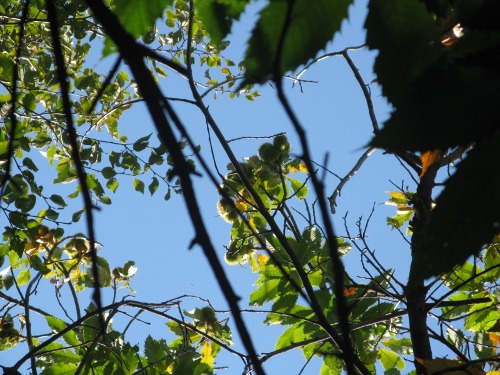
You can't find yourself suddenly face-to-face with a species that is for all intents and purposes nearly extinct, and not feel mesmerized. Not feel put on trial, not feel compelled to answer the question, how can we do better? How can we learn from the inadvertent mistakes of the past? Our understanding of forestry and forest management is much improved from the days of the Pennsylvania quarantine, yet the onslaught of exotic invasive species continues. The Frasier fir and eastern hemlock both have their devastating bugs from Asia, but treatment has been found for the hemlocks, at least, that can keep a gene pool alive. The emerald ash borer spreads slowly southward, perhaps there is hope that with education its transfer can be delayed until a suitable control can be found. Biological control in the form of a fungus has done relatively well at halting the gypsy moth's century-long oak ravaging spree. There is a native fungus that makes the chestnut blight sick, as well--it isn't currently enough to stop the blight, but it might, with time, help tip the balance scales back in favor of a partial chestnut recovery. There remain challenges, but hope as well. I am certain that learning from the past is absolutely possible.
Sources: American Chestnut: The Life, Death, and Rebirth of a Perfect Tree, Susan Freiknel.
The American Chestnut Foundation, http://www.acf.org/
Photos are taken by author, permission to redistribute them but not the text of this blog entry is granted.
Friday, September 17, 2010
I Am Totally Procrastinating Hardcore
I do not want to tell you about the somewhat ridiculousness of my life the past few weeks. I fear irony, I fear, so powerfully and utterly, failure, I am scared and frustrated and a little annoyed and oh, so weary all rolled up into one.
I have observed that conservation is a lot about how you are raised. And I do mean being raised with decent exposure to nature, so that you care about nature because you have happy memories in it but also understand it, don't fear it, and hopefully had many chances for things you observed or experience to trigger your sense of wonder.
The kind of conversation where you feel driven to do things like recycle, turn lights off, turn the heat down, never leave the water running, endeavor not to throw away uneaten food simply because you don't want to finish it--that kind of conservation is also in how you are raised. I was raised by middle-class environmentalists. We turned the light off when we left the room. We didn't leave the water running. Because we cared about conserving resources so that they might last into perpetuity or so that harmful effects could be minimized, and yes, those were some of the most important values instilled in me at an early age--but also because leaving the lights on and the water running costs money.
The people I've watched not do these things who I've known well enough to converse about it reveal that their childhood was absent such messages, whether for not having the values, or just not worrying about the money. To me, who cannot encounter a dripping faucet I can't fix and not start to feel very upset, this is extremely infuriorating.
But then I met my Significant Other, who was raised with the same values but was also raised in much less well-off circumstances. They also didn't leave the lights on, they also never left the water running. But they wouldn't even turn lights on unless they were sure to use them for a while, and kept buckets ready to collect and utilize running water. They sure as hell never threw food away, food being pretty hard-earned at times.
Half of our arguments are about me forgetting to turn some light off, or throwing something away that doesn't need to be thrown away, or failing to re-use something that had never occurred to me was possible to re-use. And I feel bad about it, because he has good reasons, it's all about the values I already have, but I have such a damned hard time remembering sometimes. I don't think about it, even though I am someone inclined to think about that sort of thing. I don't think about taking it to the level that he does, and I have tried and tried but I don't know how to make myself notice and realize.
And I get angry, when he reminds me. I get defensive and upset even though I always admit to myself that I would rather remember and do it that way because it does save some money and is more in line with my conservation values. Admittedly, he doesn't always remind me in a very patient-person sort of way, this late in the game, but I get angry even though I think he's right, because being reminded of something over and again makes a person irritable.
This is the problem with trying to espouse environmentalism to people who were not raised in a way that makes these sort of things obvious. I still think conservation is one large piece of doing what is right, because that is one my values, and those values are just as important to me as anyone else's are to them. I've run out of thought and time right now to tackle what to do about this.
I have observed that conservation is a lot about how you are raised. And I do mean being raised with decent exposure to nature, so that you care about nature because you have happy memories in it but also understand it, don't fear it, and hopefully had many chances for things you observed or experience to trigger your sense of wonder.
The kind of conversation where you feel driven to do things like recycle, turn lights off, turn the heat down, never leave the water running, endeavor not to throw away uneaten food simply because you don't want to finish it--that kind of conservation is also in how you are raised. I was raised by middle-class environmentalists. We turned the light off when we left the room. We didn't leave the water running. Because we cared about conserving resources so that they might last into perpetuity or so that harmful effects could be minimized, and yes, those were some of the most important values instilled in me at an early age--but also because leaving the lights on and the water running costs money.
The people I've watched not do these things who I've known well enough to converse about it reveal that their childhood was absent such messages, whether for not having the values, or just not worrying about the money. To me, who cannot encounter a dripping faucet I can't fix and not start to feel very upset, this is extremely infuriorating.
But then I met my Significant Other, who was raised with the same values but was also raised in much less well-off circumstances. They also didn't leave the lights on, they also never left the water running. But they wouldn't even turn lights on unless they were sure to use them for a while, and kept buckets ready to collect and utilize running water. They sure as hell never threw food away, food being pretty hard-earned at times.
Half of our arguments are about me forgetting to turn some light off, or throwing something away that doesn't need to be thrown away, or failing to re-use something that had never occurred to me was possible to re-use. And I feel bad about it, because he has good reasons, it's all about the values I already have, but I have such a damned hard time remembering sometimes. I don't think about it, even though I am someone inclined to think about that sort of thing. I don't think about taking it to the level that he does, and I have tried and tried but I don't know how to make myself notice and realize.
And I get angry, when he reminds me. I get defensive and upset even though I always admit to myself that I would rather remember and do it that way because it does save some money and is more in line with my conservation values. Admittedly, he doesn't always remind me in a very patient-person sort of way, this late in the game, but I get angry even though I think he's right, because being reminded of something over and again makes a person irritable.
This is the problem with trying to espouse environmentalism to people who were not raised in a way that makes these sort of things obvious. I still think conservation is one large piece of doing what is right, because that is one my values, and those values are just as important to me as anyone else's are to them. I've run out of thought and time right now to tackle what to do about this.
Friday, July 30, 2010
The Word Without Us
A very nice science book, though a little old by now, is The World Without Us by Alan Weisman. It is a complete thought experiment with no bearing on any real situation saving perhaps The Second Coming If You Wanna Believe That (I don't), asking what would happen to the rest of the planet if human beings just dissapeared? Not massively died, leaving our bodies to contribute carbon and nitrogen, not blew each other up, leaving nuclear fallout or just blasted landscapes...just went away. Poof. Of course that's not going to happen (see my above note about second coming), the book is interesting to me anyway becasue of its rich reseach into ecology and evolutionary biology. It does a nice little story about how we got here and to be the way we are, and how our effects have changed things, thus how things might go on changing based on what we know if we weren't here to contribute to it.
There is an important environmental message in this book, which, thankfully, is not "oh humans are so terrible look at how we've destroyed the planet wouldn't it be better off if we just left/went back to our primitive non-technological ways."
The book reminds us that we are nature, we are a species that evolved, lived, and adapted to the predators and prey who existed with us, that developed a successful set of traits for overcoming the evolutionary checks put on us by our predators and our prey, spread out of the land of our birth, and adapted ourselves to occupy pretty much the entire world. In short, a species doing what species do. We possess a damn successful set of traits allowing us to vary our diet and our tolerance of climate to encompass pretty much the whole planet--and the forces of evolution shaped us into what we are just as much as it shaped all the other species that exist with us right now. And all the environmental destruction, all of the simple change we have caused from plastic pellets in the ocean and mass extinction of other mega-fauna to our cities and towns and agricultural systems, are a product of our nature, and we are a product of nature in it's larger form. If it hadn't been us that had outsmarted the predatory checks and perfected our ability to prey on animals and learned how to manipulate the life cycle of plants to our will--maybe it would have been a different species, using whatever adaptations it had to succeed in spite of competition, and succeed on whatever terms those adaptations let it succeed. Humans are NOT the only species who, when unchecked, create environmental destruction. Since nature is very much full of inter-species competition, what we have done is not evil and callous and just as on so terrible violation of the natural world. It's not against nature at all!
In fact, what we have done has allowed us to occupy a unique position on this planet: able to recognize and contemplate our effects on other species. Recognize that we both compete directly with other species for space and right to live, but also depend on what other species to do make our lives have quality. With our needs met (this is arguable when considering all 9 billion of us), we can contemplate the needs of others, and how those needs correspond with our own, and even, sometimes, how they don't but that us living still affects them. We can make the choice to preserve endangered species that benefit us, or, more powerfully, to preserve the ones that don't really do a damn thing for us but we still have this idea that it is the right thing to do. Ideas about right and wrong come from our history as a social species, but that doesn't mean that the meaning of right and wrong do not exist just because they are of our own construction. We are in a way overcoming our nature, transcending it, to extend compassion for the sake of it to places where nature did not expressly place it to begin with. We had to follow nature to get here. But now that we are here, we have the ability to do something about it.
To me, that's environmentalism. First, protecting the things that protect you, like air, waterways, and topsoil, like species that are useful because of biological adaptations that we don't have but benefit from: latex trees, rumen stomachs, working forests that take dirt out of air and water through natural filtration and protect against soil erosion besides. But also, philosophically, because we have transformed our world to suit our needs and so now have the ability to afford to be ethical: because we recognize that our actions have consequences for others, others being not necessarily members of the human species. Caring enough to maybe try to redefine needs as wants, and try to do a little less harm. We are damn special because we can care about harm, because the nature of surviving usually doesn't allow it.
And that's bleeding-heart liberalism if anything ever was.
There is an important environmental message in this book, which, thankfully, is not "oh humans are so terrible look at how we've destroyed the planet wouldn't it be better off if we just left/went back to our primitive non-technological ways."
The book reminds us that we are nature, we are a species that evolved, lived, and adapted to the predators and prey who existed with us, that developed a successful set of traits for overcoming the evolutionary checks put on us by our predators and our prey, spread out of the land of our birth, and adapted ourselves to occupy pretty much the entire world. In short, a species doing what species do. We possess a damn successful set of traits allowing us to vary our diet and our tolerance of climate to encompass pretty much the whole planet--and the forces of evolution shaped us into what we are just as much as it shaped all the other species that exist with us right now. And all the environmental destruction, all of the simple change we have caused from plastic pellets in the ocean and mass extinction of other mega-fauna to our cities and towns and agricultural systems, are a product of our nature, and we are a product of nature in it's larger form. If it hadn't been us that had outsmarted the predatory checks and perfected our ability to prey on animals and learned how to manipulate the life cycle of plants to our will--maybe it would have been a different species, using whatever adaptations it had to succeed in spite of competition, and succeed on whatever terms those adaptations let it succeed. Humans are NOT the only species who, when unchecked, create environmental destruction. Since nature is very much full of inter-species competition, what we have done is not evil and callous and just as on so terrible violation of the natural world. It's not against nature at all!
In fact, what we have done has allowed us to occupy a unique position on this planet: able to recognize and contemplate our effects on other species. Recognize that we both compete directly with other species for space and right to live, but also depend on what other species to do make our lives have quality. With our needs met (this is arguable when considering all 9 billion of us), we can contemplate the needs of others, and how those needs correspond with our own, and even, sometimes, how they don't but that us living still affects them. We can make the choice to preserve endangered species that benefit us, or, more powerfully, to preserve the ones that don't really do a damn thing for us but we still have this idea that it is the right thing to do. Ideas about right and wrong come from our history as a social species, but that doesn't mean that the meaning of right and wrong do not exist just because they are of our own construction. We are in a way overcoming our nature, transcending it, to extend compassion for the sake of it to places where nature did not expressly place it to begin with. We had to follow nature to get here. But now that we are here, we have the ability to do something about it.
To me, that's environmentalism. First, protecting the things that protect you, like air, waterways, and topsoil, like species that are useful because of biological adaptations that we don't have but benefit from: latex trees, rumen stomachs, working forests that take dirt out of air and water through natural filtration and protect against soil erosion besides. But also, philosophically, because we have transformed our world to suit our needs and so now have the ability to afford to be ethical: because we recognize that our actions have consequences for others, others being not necessarily members of the human species. Caring enough to maybe try to redefine needs as wants, and try to do a little less harm. We are damn special because we can care about harm, because the nature of surviving usually doesn't allow it.
And that's bleeding-heart liberalism if anything ever was.
Sunday, July 4, 2010
Carbon Emissions: The Big Speculative Hoop-la
Got this link from Jeff a while ago: Walking to the shops 'damages planet more than going by car.'
The idea is that, assuming one re-consumes the calories one burns while disdaining a car in order to walk to a destination, the carbon emissions coming from the raising, slaughtering, and transporting your caloric food source actually outstrip the carbon emissions from burning the small amount of gasoline you would have burned to drive instead. The big greenwashed news: everything you thought about being a "green" citizen was a lie! Just drive baby, drive!
This article is extremely silly, either because the author didn't sum the book (How to Live a Low-Carbon Life) it draws from correctly, the author of the book (Chris Goodall) didn't have his thinking together, or both. The title is rigged and oversimplified merely to create sensationalism. Although meat consumption is extremely heavy on the greenhouse gases; what with the landspace required in raising the animals and the food for 'em, the CO2 in slaughtering packing and transporting, and the methane, 20 times more potent a GG than CO2, that cows...err, emit with regularity--there are still several, hummer-sized holes in the argument.
First is the simplicity of the one data point which drives the whole statement:
“If you walked [3 km] instead [of driving], it would use about 180 calories. You’d need about 100g of beef to replace those calories, resulting in 3.6kg of emissions, or four times as much as driving."
When people need between 1500 and 3500 calories per day, 180 is hardly noteworthy, whether you eat beef or anything else. With obesity and/or weight-obsession being what it is, many people could stand to or would love to just not replace those 180.
Certainly it's not entirely helpful for me to say that calories burned by being more active should not be replaced, but this argument is negated by its oversimplification in another way as well. Pardon me for being one of those pushy holier-than-thou vegetarians, but is 100g of beef really the only way to replace 180 calories? The article was written for a British audience, a country for which a majority of most foods both animal and vegetable are shipped long distances--but beef was specifically chosen as the data point that arrived at the four-times-as-much touchpoint. I know some people do see meat-as-whole-meal, but they may often not be the people who are walking 3km instead of driving to begin with. The reality of the matter is that people do eat too much meat to curb our carbon emissions, but the one-to-one beef-for-calories argument is way too oversimplified. I want to see the carbon comparison for something besides carnivory.
Granted, on the isolated and rainy Great Island Monarch, many food choices make carbon emissions. The article is saying that life-cycle consideration are important. So important, in fact, that the failure of the author to include life-cycle costs in the thing he is comparing--the life-cycle cost of drilling for, refining, and shipping that gasoline, or the materials for your automobile, for that matter--is as glaring error in logic.
I haven't researched them, so I don't know what those life-cycle costs are directly, thus I can't say how they compare to the CO2 and methane of 100g of beef. Perhaps the author of the book, if not the article, has looked into them. However, they are not mentioned, and some critical thinking suggests that such an omission is hardly trivial. Drilling uses fossil fuels, and certainly removes any trees and greenery--natural carbon sinks--from the land in question. Refining the stuff is going to use some energy, to say the least. And fossil fuel isn't exactly Britain's great natural resource, either, so just as you're boating and flying and trucking in the meat and out-of-season fruits and vegetables, so are you flying and boating and trucking in the oil. Car parts are also mined, forged, assembled, and shipped all over the world.
Perhaps the carbon emissions from beef are still worse. But you can't make conclusive statements until you consider all of the evidence, especially when the whole premise of your argument is based on considering hidden factors.
So the article may have some food for thought in it (pardon the pun), but it's not actually saying anything particularly profound. In fact, considering what it has left out, it may not be saying anything new at all. If you want to save the environment, you're better off reducing your meat consumption AND walking 3 kilometers.
The idea is that, assuming one re-consumes the calories one burns while disdaining a car in order to walk to a destination, the carbon emissions coming from the raising, slaughtering, and transporting your caloric food source actually outstrip the carbon emissions from burning the small amount of gasoline you would have burned to drive instead. The big greenwashed news: everything you thought about being a "green" citizen was a lie! Just drive baby, drive!
This article is extremely silly, either because the author didn't sum the book (How to Live a Low-Carbon Life) it draws from correctly, the author of the book (Chris Goodall) didn't have his thinking together, or both. The title is rigged and oversimplified merely to create sensationalism. Although meat consumption is extremely heavy on the greenhouse gases; what with the landspace required in raising the animals and the food for 'em, the CO2 in slaughtering packing and transporting, and the methane, 20 times more potent a GG than CO2, that cows...err, emit with regularity--there are still several, hummer-sized holes in the argument.
First is the simplicity of the one data point which drives the whole statement:
“If you walked [3 km] instead [of driving], it would use about 180 calories. You’d need about 100g of beef to replace those calories, resulting in 3.6kg of emissions, or four times as much as driving."
When people need between 1500 and 3500 calories per day, 180 is hardly noteworthy, whether you eat beef or anything else. With obesity and/or weight-obsession being what it is, many people could stand to or would love to just not replace those 180.
Certainly it's not entirely helpful for me to say that calories burned by being more active should not be replaced, but this argument is negated by its oversimplification in another way as well. Pardon me for being one of those pushy holier-than-thou vegetarians, but is 100g of beef really the only way to replace 180 calories? The article was written for a British audience, a country for which a majority of most foods both animal and vegetable are shipped long distances--but beef was specifically chosen as the data point that arrived at the four-times-as-much touchpoint. I know some people do see meat-as-whole-meal, but they may often not be the people who are walking 3km instead of driving to begin with. The reality of the matter is that people do eat too much meat to curb our carbon emissions, but the one-to-one beef-for-calories argument is way too oversimplified. I want to see the carbon comparison for something besides carnivory.
Granted, on the isolated and rainy Great Island Monarch, many food choices make carbon emissions. The article is saying that life-cycle consideration are important. So important, in fact, that the failure of the author to include life-cycle costs in the thing he is comparing--the life-cycle cost of drilling for, refining, and shipping that gasoline, or the materials for your automobile, for that matter--is as glaring error in logic.
I haven't researched them, so I don't know what those life-cycle costs are directly, thus I can't say how they compare to the CO2 and methane of 100g of beef. Perhaps the author of the book, if not the article, has looked into them. However, they are not mentioned, and some critical thinking suggests that such an omission is hardly trivial. Drilling uses fossil fuels, and certainly removes any trees and greenery--natural carbon sinks--from the land in question. Refining the stuff is going to use some energy, to say the least. And fossil fuel isn't exactly Britain's great natural resource, either, so just as you're boating and flying and trucking in the meat and out-of-season fruits and vegetables, so are you flying and boating and trucking in the oil. Car parts are also mined, forged, assembled, and shipped all over the world.
Perhaps the carbon emissions from beef are still worse. But you can't make conclusive statements until you consider all of the evidence, especially when the whole premise of your argument is based on considering hidden factors.
So the article may have some food for thought in it (pardon the pun), but it's not actually saying anything particularly profound. In fact, considering what it has left out, it may not be saying anything new at all. If you want to save the environment, you're better off reducing your meat consumption AND walking 3 kilometers.
Thursday, June 3, 2010
Plastic Bags, The Eternal Question
NPR: California Moves to Ban Plastic Bags in Grocery Stores:
"The California Assembly on Wednesday passed legislation prohibiting pharmacies and grocery, liquor and convenience stores from giving out plastic bags. The bill also calls for customers to be charged for using store-issued paper bags."
Environmentalists hooray, right?
"Requiring stores to charge customers for paper bags is a cost Republican lawmakers argued some Californians can't afford.
"This is not the time to be putting a financial burden on families in a very tough economy," said Assemblyman Ted Gaines, R-Granite Bay, who estimated his family would spend $50 a year on paper bags."
"Sacramento shopper Brett Akacin, 37, said he recycles his plastic bags and that it would be a burden to carry a disposable bag."
Ah, the existential problem of being an environmentalist. There will always be people who assume you care more about plants and fuzzy animals than about the suffering of people.
Maybe those people are right, though if you have the values of caring about the impact your actions have on people, creatures and things outside of yourself--and especially appreciating the importance of working systems of animals and plants for the continued health of people--you are going to be perfectly willing to induce a little suffering on yourself, hardly thinking of it as such, and will fail to understand why others begrudge to do the same thing for the sake of The Greater Good. To an environmentalist, carrying reusable bags or paying an extra five cents even if quite poor, is not suffering, and the idea of helping The Greater Good, is a value in itself.
That's why, Ah-nold excluded, environmentalists are mostly (but not always) Democrats. Personal sacrifice for the Greater Good, in situations where agregate individual behavior benefits the individual but harms the community, is the more important value than personal freedom merely for the sake of it. Rather like how shouting "Fire!" in a public building is not really freedom of speech, Democratic environmentalists point to outcomes as reasons that absolute personal freedoms require some restrictions.
But you know, another way to look at enviromentalism, or self-scarifice for the Greater Good in general, is that having the personal freedom to make a choice that benefits the Greater Good is what makes that choice not something one does grudgingly, not something one even sees as a sacrifice or as suffering. One is excercizing one's capacity as a member of a society under a social contract, a social contract that only works because people have the freedom to act upon their ideas of right and wrong.
So, do you legislate society-bettering practices for all, like a Democrat, or do you uphold that the personal freedom to desist or not from harmful acts is what makes any of it meaningful, what must be protected above all because otherwise lies tyranny?
I myself have a hard time sympathizing with the burden one must take on in order to carry reusable bags around, when compared to many other real burdens that people suffer across the world. I see the argument about personal freedom, about the meaning of having personal freedom to make self-sacrificing choices rather than being required to make them. But I see what is practical too, and what works imperfectly to make happen a change that might be democratically agreed upon as being necessary. Do you assume that people are no better than marginally-agreed-upon progress using less-than-ideal methods? Or do you throw out possible measures toward fixing a problem, for the sake of idealism?
Maybe that's why I can't decide, sometimes, if I'm a liberal or a libertarian.
While the idea gives us angst here, Australia has had an outright ban on plastic bags in effect for at least five years. (My source for that is my dear Australian friend, who now works in Australian government.) Australia is quite more liberal than us, and is, more tellingly, smaller in population than the state of California. Truly, when we can't even work out political ideas of much greater weight, a federal ban on plastic bags would be downright...comical, among other things (ineffective, wasteful of govn't resources, slow and insensetive to local concerns), but perhaps it is within local or state government rights to enact such a law for the sake of the local or state environment, without it falling down that slippery slope toward socialist tyranny. At what level of govenrment does "Mutual coersion mutually agreed upon" become tyranny, anyway? It depends, once again, on what you think is important.
I think once-used bags, the utter wastefullness of them, is important. The grocery association apaprently got behind the ban when it was made clear that all grocery-selling establishments would be subect to it. If stores were for whatever reason spared the expense of providing bags of any kind, assuming they only did before because it would not have been competitive not to, then I think customers would have the ability to figure something out without excess difficulty. Is that liberal, or libertarian of me?
"The American Chemistry Council estimates the bill would amount to a $1 billion tax and threaten 500 jobs in the plastic bag manufacturing business."
Either way you go, someone loses. But I don't think that means that nothing can be done.
"The California Assembly on Wednesday passed legislation prohibiting pharmacies and grocery, liquor and convenience stores from giving out plastic bags. The bill also calls for customers to be charged for using store-issued paper bags."
Environmentalists hooray, right?
"Requiring stores to charge customers for paper bags is a cost Republican lawmakers argued some Californians can't afford.
"This is not the time to be putting a financial burden on families in a very tough economy," said Assemblyman Ted Gaines, R-Granite Bay, who estimated his family would spend $50 a year on paper bags."
"Sacramento shopper Brett Akacin, 37, said he recycles his plastic bags and that it would be a burden to carry a disposable bag."
Ah, the existential problem of being an environmentalist. There will always be people who assume you care more about plants and fuzzy animals than about the suffering of people.
Maybe those people are right, though if you have the values of caring about the impact your actions have on people, creatures and things outside of yourself--and especially appreciating the importance of working systems of animals and plants for the continued health of people--you are going to be perfectly willing to induce a little suffering on yourself, hardly thinking of it as such, and will fail to understand why others begrudge to do the same thing for the sake of The Greater Good. To an environmentalist, carrying reusable bags or paying an extra five cents even if quite poor, is not suffering, and the idea of helping The Greater Good, is a value in itself.
That's why, Ah-nold excluded, environmentalists are mostly (but not always) Democrats. Personal sacrifice for the Greater Good, in situations where agregate individual behavior benefits the individual but harms the community, is the more important value than personal freedom merely for the sake of it. Rather like how shouting "Fire!" in a public building is not really freedom of speech, Democratic environmentalists point to outcomes as reasons that absolute personal freedoms require some restrictions.
But you know, another way to look at enviromentalism, or self-scarifice for the Greater Good in general, is that having the personal freedom to make a choice that benefits the Greater Good is what makes that choice not something one does grudgingly, not something one even sees as a sacrifice or as suffering. One is excercizing one's capacity as a member of a society under a social contract, a social contract that only works because people have the freedom to act upon their ideas of right and wrong.
So, do you legislate society-bettering practices for all, like a Democrat, or do you uphold that the personal freedom to desist or not from harmful acts is what makes any of it meaningful, what must be protected above all because otherwise lies tyranny?
I myself have a hard time sympathizing with the burden one must take on in order to carry reusable bags around, when compared to many other real burdens that people suffer across the world. I see the argument about personal freedom, about the meaning of having personal freedom to make self-sacrificing choices rather than being required to make them. But I see what is practical too, and what works imperfectly to make happen a change that might be democratically agreed upon as being necessary. Do you assume that people are no better than marginally-agreed-upon progress using less-than-ideal methods? Or do you throw out possible measures toward fixing a problem, for the sake of idealism?
Maybe that's why I can't decide, sometimes, if I'm a liberal or a libertarian.
While the idea gives us angst here, Australia has had an outright ban on plastic bags in effect for at least five years. (My source for that is my dear Australian friend, who now works in Australian government.) Australia is quite more liberal than us, and is, more tellingly, smaller in population than the state of California. Truly, when we can't even work out political ideas of much greater weight, a federal ban on plastic bags would be downright...comical, among other things (ineffective, wasteful of govn't resources, slow and insensetive to local concerns), but perhaps it is within local or state government rights to enact such a law for the sake of the local or state environment, without it falling down that slippery slope toward socialist tyranny. At what level of govenrment does "Mutual coersion mutually agreed upon" become tyranny, anyway? It depends, once again, on what you think is important.
I think once-used bags, the utter wastefullness of them, is important. The grocery association apaprently got behind the ban when it was made clear that all grocery-selling establishments would be subect to it. If stores were for whatever reason spared the expense of providing bags of any kind, assuming they only did before because it would not have been competitive not to, then I think customers would have the ability to figure something out without excess difficulty. Is that liberal, or libertarian of me?
"The American Chemistry Council estimates the bill would amount to a $1 billion tax and threaten 500 jobs in the plastic bag manufacturing business."
Either way you go, someone loses. But I don't think that means that nothing can be done.
Sunday, May 30, 2010
Yard Waste
A few years ago I went to Australia. Sister descendant of the British motherland that it is, although the eastern half (and probably the western half too) had been experiencing one of the most severe droughts in the country's history, still the Australians clung to that stately British idea of well-manicured grasses as ground covering for human-occupied spaces.
Seeing as the drought had caused the government to implement severe water restrictions (how socialist of them), that dream was clearly clung to with considerable delusion: most everybody's short (and not because they mow it) lawn was yellow-brown.
Quite a few of my Australian friends apologized to me for all the dead grass, some even profusely. As if I, hailing from one of North America's temperate rain forests, would find it some ghastly breach of etiquette, some indication of Australian society's inferiority due to lack of ability to control nature.
On the scale of things, I find lawns a somewhat absurd idea. They keep the wildness of Real Nature (which is considerable, in a temperate rain forest) from encroaching on your house, and they look nice--when you're living on a continent to which the species used are remotely adapted. But with things in mind like global food and water shortages, not to mention that Climate Change thing that gets you labeled as a no-good-hippie-alarmist if you mention it, dedicating sections of land to short green grass really does seem, well, extravagant and wasteful. Millions barely get by with subsistence farming on marginal soils, and here some folks dump nitrogen and all-valuable drinkable water into already-pretty-decent soil with no intention of using that space for food production. We go on and on about needing to cut our carbon emissions for the sake of our future, yet we fail to see the hilarity in using gas-powered engines once a week or so just to forestall the undaunted efforts of a plant to get a little taller.
According to 2000 census projections, in 2008 there were 112 million occupied American households. 63.2% of those were detached, which for simplicity will be my only area of focus--even though apartment building, mobile homes, government areas and businesses often have lawn areas as well--so we can estimate that there were 71million American lawns of some size or other. According to the American Housing Survey data tables, the median lot size of occupied housing in 2008 was 0.36 acres, and the median house size was 1800 square feet. Subtract house square footage from 0.36 acres * 43,560 square feet per acre, and you get a rough estimate of 0.32 acres of yard per household. Multiply that by 71 million occupied households, and you get 23 million acres of private lawn.
Lawn mower efficiency is a pretty difficult concept to pin down, because it varies based on size, type, and age, and isn't generally advertised or noticed. Because they are smaller, lighter, and have a less complicated cycle than car engines, one could argue that they are much more fuel efficient than cars; however, they burn a heck of a lot dirtier, not being as as regulated as car engines. For the sake of forging ahead, and at risk of making this whole thing even more arbitrary than it already is, I'm going to throw out a guess of one cup of gasoline per acre, based on minimal experience mowing a 1.5 acre yard with a tiny 1980s push mower. So that's 23 million cups of gasoline, burned once a week throughout warm months, we'll say half the year. 598 million cups of gasoline. According to the EPA, 1 gallon of gasoline yields 19.4 pounds of CO2--that varies too based on the efficiency of combustion, which for lawn mowers probably is not particularly great. But lacking a better number, we'll take that one, so that 598 million cups of gasoline * 16 cups to a gallon * 19.4 pounds of CO2 to a gallon gives you a grand and arbitrary total of...186 billion pounds of CO2 in a year. 84 million metric tons, if you like.
All based on not-well-pinned-down numbers, but we can't deny that is is a darn lot of CO2, thrown up there in the name of neatness and conformity. Considering the supposed scope and potential of human ingenuity, it is pretty darn silly.
Seeing as the drought had caused the government to implement severe water restrictions (how socialist of them), that dream was clearly clung to with considerable delusion: most everybody's short (and not because they mow it) lawn was yellow-brown.
Quite a few of my Australian friends apologized to me for all the dead grass, some even profusely. As if I, hailing from one of North America's temperate rain forests, would find it some ghastly breach of etiquette, some indication of Australian society's inferiority due to lack of ability to control nature.
On the scale of things, I find lawns a somewhat absurd idea. They keep the wildness of Real Nature (which is considerable, in a temperate rain forest) from encroaching on your house, and they look nice--when you're living on a continent to which the species used are remotely adapted. But with things in mind like global food and water shortages, not to mention that Climate Change thing that gets you labeled as a no-good-hippie-alarmist if you mention it, dedicating sections of land to short green grass really does seem, well, extravagant and wasteful. Millions barely get by with subsistence farming on marginal soils, and here some folks dump nitrogen and all-valuable drinkable water into already-pretty-decent soil with no intention of using that space for food production. We go on and on about needing to cut our carbon emissions for the sake of our future, yet we fail to see the hilarity in using gas-powered engines once a week or so just to forestall the undaunted efforts of a plant to get a little taller.
According to 2000 census projections, in 2008 there were 112 million occupied American households. 63.2% of those were detached, which for simplicity will be my only area of focus--even though apartment building, mobile homes, government areas and businesses often have lawn areas as well--so we can estimate that there were 71million American lawns of some size or other. According to the American Housing Survey data tables, the median lot size of occupied housing in 2008 was 0.36 acres, and the median house size was 1800 square feet. Subtract house square footage from 0.36 acres * 43,560 square feet per acre, and you get a rough estimate of 0.32 acres of yard per household. Multiply that by 71 million occupied households, and you get 23 million acres of private lawn.
Lawn mower efficiency is a pretty difficult concept to pin down, because it varies based on size, type, and age, and isn't generally advertised or noticed. Because they are smaller, lighter, and have a less complicated cycle than car engines, one could argue that they are much more fuel efficient than cars; however, they burn a heck of a lot dirtier, not being as as regulated as car engines. For the sake of forging ahead, and at risk of making this whole thing even more arbitrary than it already is, I'm going to throw out a guess of one cup of gasoline per acre, based on minimal experience mowing a 1.5 acre yard with a tiny 1980s push mower. So that's 23 million cups of gasoline, burned once a week throughout warm months, we'll say half the year. 598 million cups of gasoline. According to the EPA, 1 gallon of gasoline yields 19.4 pounds of CO2--that varies too based on the efficiency of combustion, which for lawn mowers probably is not particularly great. But lacking a better number, we'll take that one, so that 598 million cups of gasoline * 16 cups to a gallon * 19.4 pounds of CO2 to a gallon gives you a grand and arbitrary total of...186 billion pounds of CO2 in a year. 84 million metric tons, if you like.
All based on not-well-pinned-down numbers, but we can't deny that is is a darn lot of CO2, thrown up there in the name of neatness and conformity. Considering the supposed scope and potential of human ingenuity, it is pretty darn silly.
Monday, February 8, 2010
The Thing about Hybrids
Like a good environmentalist, I should be excited about all the new hybrid models out, right?
Well, because I love the Nissan Altima so much, that being my first car and all, I'm pretty excited about that one. It's also pretty stupid to use the first-generation of some technology, like people did with the first Priuses (Prii?) and with solar photovoltaic kits bought at Lowes, see the flaws and assume it just means the technology doesn't work at all, when really it's still being developed. But really, though it's good to keep the technology possibilities going, I'm pretty much convinced that battery powered fuel-electric hybrids, at least, aren't the thing that's gonna work for us here in America.
First off, the fuel economy of hybrids isn't really all that spectacular, especially of hybrid SUVS. Like a true environmentalist, I am not a fan, and hybrid SUVS might be a genuine great thing for people who genuinely need an SUV, but are sort of a feel-good excuse to help us keep our bad habits. There's even some evidence to suggest that the feel-good aspect of these cars makes a fair number of people justify driving more, because hey, driving's not bad anymore if you have a hybrid.
Yet the main issue is that the hybrid concept isn't that applicable to the United States, because the country is for the most part, a very spread out place. People in the US do have a huge problem with driving when they shouldn't, like my friend who drives the 0.5 miles to the gym so she can walk around the track. We aren't going to get real change in our pollution environment until we fix this mentality where it is possible to fix it, and because human nature is in the way, that is no easy thing to do.
But Americans also drive many places they really should drive to, because a lot of us live so far from stores that walking would be ridiculously impracticable, because there's no space for you on our traveling surfaces if you're a tiny bike-rider or a tiny walker, and you're likely to get hit on or yelled at besides, if not killed by someone who doesn't see you cause he or she is texting. We travel between spread-out suburbs and spread-out cities regularly for work, family, friends and attractions, and if we had to walk or bike, our productivity would plummet (though so would obesity rates). We live this way because there is so much space, so it gets filled with lots of stuff, and most people can't locate themselves to live in walking or biking distance to all of it, even those who are walking or biking inclined.
Public transport and good city planning is the answer to this, but I don't think people are going to give up private vehicles all together, because the space issue is an obstacle to public transit as well. How do you design a route that takes care of all of it in a time and cost efficient manner? Hybrids don't much help the space problem, because when you're traveling between North and East side of town you go a dozen miles at highway speeds, not a few miles with lots of breaking, where hybrids do their best work. When you make your monthly trip to the next state over to visit grandma, you're electric battery is never even going to cut on.
I have some friends, who happen to be unnaturally obsessed with volts-wagon diesel vehicles, which also tend to kick your hybrid's mpg-ass with what they clock traveling between their college town and their hometown. I certainly think they have the right of it: those German cars are designed for Audubon-reminiscent, high-speed efficiency, and that is why their gas mileage in our country always ends up being comparable.
Well, because I love the Nissan Altima so much, that being my first car and all, I'm pretty excited about that one. It's also pretty stupid to use the first-generation of some technology, like people did with the first Priuses (Prii?) and with solar photovoltaic kits bought at Lowes, see the flaws and assume it just means the technology doesn't work at all, when really it's still being developed. But really, though it's good to keep the technology possibilities going, I'm pretty much convinced that battery powered fuel-electric hybrids, at least, aren't the thing that's gonna work for us here in America.
First off, the fuel economy of hybrids isn't really all that spectacular, especially of hybrid SUVS. Like a true environmentalist, I am not a fan, and hybrid SUVS might be a genuine great thing for people who genuinely need an SUV, but are sort of a feel-good excuse to help us keep our bad habits. There's even some evidence to suggest that the feel-good aspect of these cars makes a fair number of people justify driving more, because hey, driving's not bad anymore if you have a hybrid.
Yet the main issue is that the hybrid concept isn't that applicable to the United States, because the country is for the most part, a very spread out place. People in the US do have a huge problem with driving when they shouldn't, like my friend who drives the 0.5 miles to the gym so she can walk around the track. We aren't going to get real change in our pollution environment until we fix this mentality where it is possible to fix it, and because human nature is in the way, that is no easy thing to do.
But Americans also drive many places they really should drive to, because a lot of us live so far from stores that walking would be ridiculously impracticable, because there's no space for you on our traveling surfaces if you're a tiny bike-rider or a tiny walker, and you're likely to get hit on or yelled at besides, if not killed by someone who doesn't see you cause he or she is texting. We travel between spread-out suburbs and spread-out cities regularly for work, family, friends and attractions, and if we had to walk or bike, our productivity would plummet (though so would obesity rates). We live this way because there is so much space, so it gets filled with lots of stuff, and most people can't locate themselves to live in walking or biking distance to all of it, even those who are walking or biking inclined.
Public transport and good city planning is the answer to this, but I don't think people are going to give up private vehicles all together, because the space issue is an obstacle to public transit as well. How do you design a route that takes care of all of it in a time and cost efficient manner? Hybrids don't much help the space problem, because when you're traveling between North and East side of town you go a dozen miles at highway speeds, not a few miles with lots of breaking, where hybrids do their best work. When you make your monthly trip to the next state over to visit grandma, you're electric battery is never even going to cut on.
I have some friends, who happen to be unnaturally obsessed with volts-wagon diesel vehicles, which also tend to kick your hybrid's mpg-ass with what they clock traveling between their college town and their hometown. I certainly think they have the right of it: those German cars are designed for Audubon-reminiscent, high-speed efficiency, and that is why their gas mileage in our country always ends up being comparable.
Subscribe to:
Posts (Atom)